Portrait of St. Fidgeta by Marilyn Fitschen.
Friday, April 29, 2005
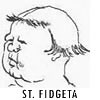


Fidgeta is Found!
Rejoice with me, for the book of St. Fidgeta has been found! I feel like the woman in the parable who searched for the lost coin. Thanks to those of you who gave suggestions for obtaining a replacement.
In commemoration of this eventful day, herewith some readings from the Book of Fidgeta.
(Lawyerese small print: St. Fidgeta and Other Parodies by John Bellairs, The MacMillian Company, 1966).
" Facts About St. Fidgeta
St. Fidgeta is the patroness of nervous and unmanageable children. Her shrine is the church of Santa Fidgeta in Tormento, near Fobbio in southern Italy. There one may see the miraculous statue of St. Fidgeta...
This statue has been seen to squirm noticeably on her feast day, and so on that day restless children from all over Europe have been dragged to the shrine by equally nervous, worn-out and half-mad parents. Though no diminution has been noticed in the fidgeting of those children, the feeling is that the restlessness will at least be converted into meritorious work by the action of the saint.
On this point, see Tertullian, who proves that fidgeting is (or can be) useful unto salvation. Also, see Gregory of Mopsuestia, on fidgeting as a prelude to mystical experience."
In my previous post, I made reference to St. Adiposa, one of the members of the Order of the Faithful Fidgettines (O.F.F.) who lived in the first Fidgettine convent built next to the church of Santa Fidgeta in Tormento.
Another famous saint from the order was St. Pudebunda "who on her wedding night decided that God had called her to a life of spotless virginity. The causes of her death that very night are not known, but the pious may guess at them. She was posthumously admitted to the order."
Let us pray:
Prayer Against Enemies
(Attributed to St. Dragomira--more about her another day)
(Attributed to St. Dragomira--more about her another day)
"O Fidgeta, who dost cause the unrighteous to scratch where it does not itch, grant that the hateful N. may be afflicted with tickles, the stitch, the cramp, underarm rash, prickly foot and all manner of unexplained twinges."
Here endeth the lesson.
Thursday, April 28, 2005
Reflections on Walls in Afghanistan
My nephew forwarded an email from a friend of his who is now working in Afghanistan because El Jefe knew him also. I am excerpting parts of the email, which was the transcript of his speech at the Ministry of Foreign Affairs in Kabul to share his intriguing observations about walls and volunteerism. His "nom de plume" is Kabul Corporate Monk #14.
____________________________________________________________________
____________________________________________________________________
As I drive around Afghanistan, I am amazed by the sheer number and variety of the walls. Most are made of carefully assembled mud, with mud and thatch daub for a cornice to protect the wall from early erosion. Others are made painstakingly of fired bricks. In Kabul, I have seen walls made from materials I've never seen anywhere else: Hesco barriers, made of felt enclosed in wire mesh and filled with dirt. To be completely inclusive, I admit that the US Embassy is the only edifice I've seen anywhere that has steel plate walls. And, of course, those steel plate walls, like all of the Hesco barriers, is adorned with the most appealing spirals of razor ribbon.
But as amazing to me as the walls in Afghanistan are the carefully tended areas inside the walls, on the few times that I have been able to catch a glimpse inside. From both observation and reading, I understand that within Afghan culture, there is a whole world inside the walls - largely comprised of the women and children -- that is deeply intimate and intended to be separated from the world outside the wall...
One common characteristic I have observed in countries that have lots of walls is that there is usually a great disparity between the conditions inside the wall and those outside. The inside courtyard will be tidy and well-decorated, while the areas immediately outside the wall will often be filled with garbage and bear the look of total abandonment. The territory inside the walls and the territory outside the walls might as well be in different worlds.
In contrast, there are not so many walls in America. Obviously there are some walls, but far more common are the wide open lawns with sidewalks and pathways leading right up to the front door. If there are walls, they are more commonly little fences that even a child can see through or over - intended more to keep a dog inside than a person out. In America, there are not such large and clear boundaries between what belongs to me and what belongs to us all.
Very often in America, it will be difficult for an observer to tell exactly which property belongs to which person. Whole expanses of green grass and flowers will be planted and tended and nurtured as if they were all the private domain of a single individual, when in fact the spaces are the common property of many neighbors, many of whom do not even know the names of the others. Many of the most valuable features of America can be summed up in the way people care for public and private space. In America, the private and public worlds can easily blend together.
There is a parallel in America to the physical openness I have just described in the way family and the broader society are treated by individuals. Obviously Americans have families, and in the vast majority of cases those families are deeply treasured by their members... Just as private yards in America begin to blend into the public areas of the larger community, so too do relationships of connectedness and commitment - at least in the best parts of America -- extend far beyond the bounds of family and clan.
It is my judgment that it is this phenomenon of Americans' blurring the lines separating what is distinctly theirs and what belongs to the larger community - whether we are talking about real estate or relationships - that explains one of the greatest national character traits of America: our volunteerism. Americans have, since our early years as a nation, shown a tendency to involve ourselves in activities and commit ourselves to groups whose boundaries extend far beyond the divisions of property rights and bloodlines. It is this tendency, I believe, that is at the core of America's power and greatness as a nation. It is because so many of us are willing to merge our lives and treasures with those of others of our countrymen with whom we have no connection other than trust in a common vision that we have been able to achieve so much more than could have been expected from a motley group of immigrants from every corner of the globe.
As we have torn down the walls of division between us - both physical and personal - we have been able to tap ever deeper reservoirs of common strength and ability. And we tap these reservoirs in the selfless acts of volunteering to be part of something that is more than ourselves...
My presence in the country and at the Embassy, which enabled me to make the decision to come and speak, is itself another act of joining. I am an employee of the United States Government now. But previously, I was an officer in a large corporation. I took a 90% reduction in pay to come take this job. Did I take this economic hit because of my great love of Afghanistan? Well, if I knew that I would come to love Afghanistan as much as I do, then maybe the financial sacrifice would have been worth it, but really, I hardly knew anything about Afghanistan when I sought this job. I gave up my other job - at least temporarily - because I wanted to join in a project that was important to America - the reconstruction of Afghanistan -- and being a part of that larger project became more important to me than money, time with my family, and arguably even life itself.
...
In arts, education, religion, and every other form of human activity, Americans exhibit an impulse to join others that is unmatched anywhere in the world. Americans even have "associations of associations." The source of this energy must come from the experience of uprooting that occurred at the founding of America, and that still occurs frequently today. The early settlers of America were brave souls who had often rejected their former homelands and unavoidably left their families or at least their extended complex of relatives also behind. And this was no temporary parting. When America's founders left the shores of England and Scotland, and then Holland and later Ireland and Germany, they had no intention of ever returning, often despising the country they put behind them.
This attitude of permanent rejection made America's settlers different from the settlers of many other countries. Throughout Latin America, large numbers of Spaniards came to find wealth and adventure. Even though many of them lived the entire rest of their lives in the Americas and their descendants became the mixed-blood progeny of Spaniards and indigenous peoples, the intent of most Spanish settlers was to return to Spain when their fortunes had been secured. And, among the French settlers, though fewer in number than the English and the Spanish, and lacking the same mercantilist approach as the Spanish, were attitudinally the opposite of the English. French settlers loved France and sought to bring it with them to the new world and to create in their new home a microcosm of their old home.
And, what is the significance of these attitudinal differences. Well, for the Spanish, they had no incentive to create anything new, because they fully expected to return and, for the French, they wanted only to replicate what they had left behind. It fell to the English and Scottish settlers to create a totally new culture in their new nation, because they had so fully and irreversibly ripped themselves from the family and cultural moorings that had tied them to their former homelands.
We human beings are social creatures and will inevitably seek comfort in associational structures. Uninterrupted, we will preserve those associational structures that are most familiar to us: family and clan. Perhaps only in the chaotic Diaspora that formed America was the activation energy of an entire culture reached so that the bonds of association that had bound us for eons loosened sufficiently that new connections based on common interest, vision and hope could form. In the world of today with digital communication and inter-continental jet aircraft, the irreversibility and permanence of any immigration is lessened and a move to America is not at all the same experience of separation as it was 300 years ago. Yet, because of the radical pace, freedom and bombardment of experience that is inescapable in the modern American experience, the immigrants of today are forced to find new associational hand-holds to stabilize themselves in their new world, and their clutching for new relationships that are different from any that they knew before makes them more distinctively American, even as they are being jarred out of their skins by distinctly American cultural frenzy. Our recent immigrants are adopting the same patterns of associational innovation that have characterized America's new arrivals for hundreds of years.
In the two books I have read that involve Afghan-Americans, West of Kabul, East of New York and The Kite Runner, the reader is able to see this tearing of the protagonists this way and that by the anchored rootedness of their Afghan selves and the demands for a new identity placed on them by their American experience...
The blessed consequence of all of these new connections that come through diverse associations that are the fruit of all of our joining is that we are forced to tear down the walls that separate us from others. I may not care about the trash that is outside of my house if all of those whom I care about are living within my compound. But, in the real situation in which I live back in Houston, I have a deep concern about the conditions of a whole vast territory around my house because this territory houses not just my family, but the boys in my sons' scout troop and on their sports teams and in their schools. I care about a much larger piece of geography because that geography houses a much larger group of my relational treasures than would ever occur if most of life occurred within the walls.
In America, litter is picked up, flowers are planted and trees are trimmed that do not belong to any one of us, but they belong to us all. We Americans volunteer in a multitude of ways - always in an effort to reinsert ourselves into the cocoon of associational familiarity from which we have been ripped as a nation torn away from its heritages - and in so doing we create new connections and loyalties and commitments that glue us together more tightly as a nation than countries populated by people undisturbed for centuries...
America will remain for years into the future, I believe, a nation of constant re-generation, fueled by people who are engaged in a frenzy of new connection-building. And the most fruitful and majestic expression and source of these new connections will be the constant energy of volunteerism which has set us apart as a nation since our founding.
Americans have torn down their walls and can never erect them again -- and still be America. And I, as a guest in Afghanistan, rejoice as more and more Afghans invite me into their lives outside the walls.
by: Kabul Corporate Monk #14
But as amazing to me as the walls in Afghanistan are the carefully tended areas inside the walls, on the few times that I have been able to catch a glimpse inside. From both observation and reading, I understand that within Afghan culture, there is a whole world inside the walls - largely comprised of the women and children -- that is deeply intimate and intended to be separated from the world outside the wall...
One common characteristic I have observed in countries that have lots of walls is that there is usually a great disparity between the conditions inside the wall and those outside. The inside courtyard will be tidy and well-decorated, while the areas immediately outside the wall will often be filled with garbage and bear the look of total abandonment. The territory inside the walls and the territory outside the walls might as well be in different worlds.
In contrast, there are not so many walls in America. Obviously there are some walls, but far more common are the wide open lawns with sidewalks and pathways leading right up to the front door. If there are walls, they are more commonly little fences that even a child can see through or over - intended more to keep a dog inside than a person out. In America, there are not such large and clear boundaries between what belongs to me and what belongs to us all.
Very often in America, it will be difficult for an observer to tell exactly which property belongs to which person. Whole expanses of green grass and flowers will be planted and tended and nurtured as if they were all the private domain of a single individual, when in fact the spaces are the common property of many neighbors, many of whom do not even know the names of the others. Many of the most valuable features of America can be summed up in the way people care for public and private space. In America, the private and public worlds can easily blend together.
There is a parallel in America to the physical openness I have just described in the way family and the broader society are treated by individuals. Obviously Americans have families, and in the vast majority of cases those families are deeply treasured by their members... Just as private yards in America begin to blend into the public areas of the larger community, so too do relationships of connectedness and commitment - at least in the best parts of America -- extend far beyond the bounds of family and clan.
It is my judgment that it is this phenomenon of Americans' blurring the lines separating what is distinctly theirs and what belongs to the larger community - whether we are talking about real estate or relationships - that explains one of the greatest national character traits of America: our volunteerism. Americans have, since our early years as a nation, shown a tendency to involve ourselves in activities and commit ourselves to groups whose boundaries extend far beyond the divisions of property rights and bloodlines. It is this tendency, I believe, that is at the core of America's power and greatness as a nation. It is because so many of us are willing to merge our lives and treasures with those of others of our countrymen with whom we have no connection other than trust in a common vision that we have been able to achieve so much more than could have been expected from a motley group of immigrants from every corner of the globe.
As we have torn down the walls of division between us - both physical and personal - we have been able to tap ever deeper reservoirs of common strength and ability. And we tap these reservoirs in the selfless acts of volunteering to be part of something that is more than ourselves...
My presence in the country and at the Embassy, which enabled me to make the decision to come and speak, is itself another act of joining. I am an employee of the United States Government now. But previously, I was an officer in a large corporation. I took a 90% reduction in pay to come take this job. Did I take this economic hit because of my great love of Afghanistan? Well, if I knew that I would come to love Afghanistan as much as I do, then maybe the financial sacrifice would have been worth it, but really, I hardly knew anything about Afghanistan when I sought this job. I gave up my other job - at least temporarily - because I wanted to join in a project that was important to America - the reconstruction of Afghanistan -- and being a part of that larger project became more important to me than money, time with my family, and arguably even life itself.
...
In arts, education, religion, and every other form of human activity, Americans exhibit an impulse to join others that is unmatched anywhere in the world. Americans even have "associations of associations." The source of this energy must come from the experience of uprooting that occurred at the founding of America, and that still occurs frequently today. The early settlers of America were brave souls who had often rejected their former homelands and unavoidably left their families or at least their extended complex of relatives also behind. And this was no temporary parting. When America's founders left the shores of England and Scotland, and then Holland and later Ireland and Germany, they had no intention of ever returning, often despising the country they put behind them.
This attitude of permanent rejection made America's settlers different from the settlers of many other countries. Throughout Latin America, large numbers of Spaniards came to find wealth and adventure. Even though many of them lived the entire rest of their lives in the Americas and their descendants became the mixed-blood progeny of Spaniards and indigenous peoples, the intent of most Spanish settlers was to return to Spain when their fortunes had been secured. And, among the French settlers, though fewer in number than the English and the Spanish, and lacking the same mercantilist approach as the Spanish, were attitudinally the opposite of the English. French settlers loved France and sought to bring it with them to the new world and to create in their new home a microcosm of their old home.
And, what is the significance of these attitudinal differences. Well, for the Spanish, they had no incentive to create anything new, because they fully expected to return and, for the French, they wanted only to replicate what they had left behind. It fell to the English and Scottish settlers to create a totally new culture in their new nation, because they had so fully and irreversibly ripped themselves from the family and cultural moorings that had tied them to their former homelands.
We human beings are social creatures and will inevitably seek comfort in associational structures. Uninterrupted, we will preserve those associational structures that are most familiar to us: family and clan. Perhaps only in the chaotic Diaspora that formed America was the activation energy of an entire culture reached so that the bonds of association that had bound us for eons loosened sufficiently that new connections based on common interest, vision and hope could form. In the world of today with digital communication and inter-continental jet aircraft, the irreversibility and permanence of any immigration is lessened and a move to America is not at all the same experience of separation as it was 300 years ago. Yet, because of the radical pace, freedom and bombardment of experience that is inescapable in the modern American experience, the immigrants of today are forced to find new associational hand-holds to stabilize themselves in their new world, and their clutching for new relationships that are different from any that they knew before makes them more distinctively American, even as they are being jarred out of their skins by distinctly American cultural frenzy. Our recent immigrants are adopting the same patterns of associational innovation that have characterized America's new arrivals for hundreds of years.
In the two books I have read that involve Afghan-Americans, West of Kabul, East of New York and The Kite Runner, the reader is able to see this tearing of the protagonists this way and that by the anchored rootedness of their Afghan selves and the demands for a new identity placed on them by their American experience...
The blessed consequence of all of these new connections that come through diverse associations that are the fruit of all of our joining is that we are forced to tear down the walls that separate us from others. I may not care about the trash that is outside of my house if all of those whom I care about are living within my compound. But, in the real situation in which I live back in Houston, I have a deep concern about the conditions of a whole vast territory around my house because this territory houses not just my family, but the boys in my sons' scout troop and on their sports teams and in their schools. I care about a much larger piece of geography because that geography houses a much larger group of my relational treasures than would ever occur if most of life occurred within the walls.
In America, litter is picked up, flowers are planted and trees are trimmed that do not belong to any one of us, but they belong to us all. We Americans volunteer in a multitude of ways - always in an effort to reinsert ourselves into the cocoon of associational familiarity from which we have been ripped as a nation torn away from its heritages - and in so doing we create new connections and loyalties and commitments that glue us together more tightly as a nation than countries populated by people undisturbed for centuries...
America will remain for years into the future, I believe, a nation of constant re-generation, fueled by people who are engaged in a frenzy of new connection-building. And the most fruitful and majestic expression and source of these new connections will be the constant energy of volunteerism which has set us apart as a nation since our founding.
Americans have torn down their walls and can never erect them again -- and still be America. And I, as a guest in Afghanistan, rejoice as more and more Afghans invite me into their lives outside the walls.
by: Kabul Corporate Monk #14
Wednesday, April 27, 2005
Brightening Up the Corner Where We Are
One of the reasons I decided to start blogging was to show that there are good things happening in at least one corner of the PCUSA, which is dogged nationally by declining membership and internal conflicts. So please pardon this post if it seems like bragging. I just want to share the good news about successes in the everyday ("quotidian") mission and life of our church as we try to "brighten up the corner where we are" and hopefully encourage other churches to do likewise.
The results are in and we are celebrating: the school's fundraising event netted $82K! One thousand tickets were sold for the quilt raffle, so that raised $4K alone.
We are so blessed to be concluding the school year with such good news. Not only did we get the accreditation, but registrations for the school increased enough that the school was able to propose a budget that included additional staff positions that are needed and still have a balanced budget.
Today in our staff meeting the Head of School read some of the comments from the visiting accreditation team. We are most proud of the compliments given for the positive relationship between the church and the school and the high level of parent support and involvment. So many church schools find themselves in adversarial relationships with church staff and congregations that we apparently really stood out in that regard.
As we went around the circle in the meeting, several of us recounted experiences of being in professional gatherings where we heard many "horror stories" about church/school conflicts that made us so grateful to be where we are. My father always used to observe that one of the keys to success and happiness in life was "to know when you are well off'". Most of the time the staff focuses on what fixing problems that arise every week. Today it was great to acknowledge that with the help of God we are making a difference in the lives of many children and families.
The results are in and we are celebrating: the school's fundraising event netted $82K! One thousand tickets were sold for the quilt raffle, so that raised $4K alone.
We are so blessed to be concluding the school year with such good news. Not only did we get the accreditation, but registrations for the school increased enough that the school was able to propose a budget that included additional staff positions that are needed and still have a balanced budget.
Today in our staff meeting the Head of School read some of the comments from the visiting accreditation team. We are most proud of the compliments given for the positive relationship between the church and the school and the high level of parent support and involvment. So many church schools find themselves in adversarial relationships with church staff and congregations that we apparently really stood out in that regard.
As we went around the circle in the meeting, several of us recounted experiences of being in professional gatherings where we heard many "horror stories" about church/school conflicts that made us so grateful to be where we are. My father always used to observe that one of the keys to success and happiness in life was "to know when you are well off'". Most of the time the staff focuses on what fixing problems that arise every week. Today it was great to acknowledge that with the help of God we are making a difference in the lives of many children and families.
Monday, April 25, 2005
Pope Toast
Check out Pope Toast. A tip of the zucchetto to Reverend Mommy for the link.
Okay, you knew you it was just a question of time before this would be reported. I'm sure it must have happened in South Texas, favored site for similar visitations on tortillas.
Okay, you knew you it was just a question of time before this would be reported. I'm sure it must have happened in South Texas, favored site for similar visitations on tortillas.
Accreditation Celebration
There was a breakfast reception this morning at our church's school for the team from the accreditation agency that was making their final visit before granting the school their accreditation. Looking around the room I saw many people who have worked together for the last five years to develop the school from a preschool only to one that goes through the fifth grade.
We reminisced together about the bad old early days when we had to literally fight the city council, the homeowners association in the subdivision where our church is located and the local area newspapers that criticized our plans to expand the school. When it comes to schools and churches, everyone wants them to be conveniently located but many are afflicted with NIMBY-syndrome (not in my back yard).
Oh, the wailing and gnashing of teeth over the prospect of increased traffic, increased noise of children at play on the playground, and the inconvenience of living near the construction that would be required! Oh the threatening of lawsuits and the political manuverings with the city council and the zoning board! It's little wonder that some of the churches near us sell their property located in residential areas and move to commercial locations where they won't have to deal with the gripes of their neighbors. A few years ago one neighbor even called the church to complain that we had put up a cross with a purple sash to commemorate Easter on church property on the grounds that it violated her civil rights! And as Dave Barry always says-- I am NOT making this up.
The theme song of the school should be "Amazing Grace":
Through many dangers, toils and snares
We have already come
It's grace that brought us safe this far
And grace will bring us home
The accreditation process is now complete, so the school can show the community that it meets high standards for both education and religious training. It has been done in time for our first graduating class of fifth graders to transfer to middle school from an accredited school. It is inspiring to see that how prayers, hard work and faith of the congregation, the school parents, and the school staff have brought us this day.
Sunday, April 24, 2005
No Blackberrys in the Paw-Paw Patch

This weekend El Jefe and I joined a group of friends for a road trip to Natchez. I had hoped to find some dogwood in bloom and I did! Dogwood doesn't bloom as far west as we live.
The trip couldn't have been better: the spring weather was sensational! We are all history buffs and toured some of the historical sites in the area and stayed at a charming old inn downtown.
But El Jefe found one problem in the trip: there was no wireless service in the paw-paw patch. For those of you fortunate enough not to know, a blackberry is not a summer fruit, but is a devilish wireless device that sends and receives email messages, accesses the internet and is also a cellphone. All of the attorneys at his firm are issued one and I have named him the president of Blackberrys Anonymous.
These things are highly addictive: once you get used to wearing one you are constantly feeling its vibration that signals someone wants you for something. The girls and I have been known to forcibly take the device from him as he tried to read and send emails while driving, in church, or at a social event. Ignoring it is nearly as impossible as ignoring a ringing phone. I'm working on the 12 step program for blackberry addicts, and the first step is, when you shouldn't be answering it TURN IT OFF!
El Jefe did really well once he realized that the wireless network did not extend to the paw paw patch. After wistfully checking it in several new locations once we got to Natchez he finally turned it off, although he did absent-mindedly reach for it several times. He didn't try to look at it again until this afternoon when we got back to the interstate highway. Then when he turned it on it buzzed and spit like an angry hornet as it sent and received the stored messages that came in when the device was out of range of the network.
As technology develops to keep us in constant communication, it can sometimes be a blessing when it doesn't work. Thank God there was no blackberry access in the paw-paw patch this weekend!
Thursday, April 21, 2005
Remodeling at home and church
I see it ahead! The light at the end of the kitchen remodeling project...
Today the drawers have been returned and all the painting is completed. Applicances have been released from their plastic protective coverings and the whole thing is starting to look pretty good. By the middle of next week the kitchen should be usable again. Now I'm getting impatient for the final result.
Construction is always a messy process. El Jefe can hardly bear to look while it is underway. This weekend we are escaping the kitchen chaos with a little spring road trip.
The progress I saw when I got home cheered me up as I returned from another "remodeling" project that promises to take much more time, stress and prayer. Today I was in a very long meeting where the subject was a discussion of growth in the church. Growth and change can be as messy and difficult in the church or any other organization as it is in your home. It may be easy to draw up a blueprint for growth or change but it's hard to live through it. That's why people prefer to remodel BEFORE they occupy a home if they can. It would be so much easier to try to make changes that will grow the church if we didn't have to continue to BE the church while we did it, wouldn't it?
But there's the rub. We don't get that option if we're faithful: we have to try to live with the chaos the Holy Spirit may lead us through and pray that we are following where the Spirit leads.
So I'm feeling less stressed about my kitchen remodeling than I am about the prospect of "remodeling" the church. The kitchen project is finite, but the church is eternal. I can see the result of my plans at home, but may never be sure that the plans we are trying to develop for the church will be completed.
Today the drawers have been returned and all the painting is completed. Applicances have been released from their plastic protective coverings and the whole thing is starting to look pretty good. By the middle of next week the kitchen should be usable again. Now I'm getting impatient for the final result.
Construction is always a messy process. El Jefe can hardly bear to look while it is underway. This weekend we are escaping the kitchen chaos with a little spring road trip.
The progress I saw when I got home cheered me up as I returned from another "remodeling" project that promises to take much more time, stress and prayer. Today I was in a very long meeting where the subject was a discussion of growth in the church. Growth and change can be as messy and difficult in the church or any other organization as it is in your home. It may be easy to draw up a blueprint for growth or change but it's hard to live through it. That's why people prefer to remodel BEFORE they occupy a home if they can. It would be so much easier to try to make changes that will grow the church if we didn't have to continue to BE the church while we did it, wouldn't it?
But there's the rub. We don't get that option if we're faithful: we have to try to live with the chaos the Holy Spirit may lead us through and pray that we are following where the Spirit leads.
So I'm feeling less stressed about my kitchen remodeling than I am about the prospect of "remodeling" the church. The kitchen project is finite, but the church is eternal. I can see the result of my plans at home, but may never be sure that the plans we are trying to develop for the church will be completed.
Wednesday, April 20, 2005
End of the Papal Coverage
Today the blogosphere is full of postings about the selection of the new Pope. Two of the best ones from a Protestant point of view are by Mark D Roberts and Lileks. I wish I could wax more profound on the subject than they did, so I tip my hat to them.
In a way I will miss the wall-to-wall coverage of the change in leadership for the Catholic Church that we have had for the last month or so. It has been refreshing to have serious discussions of issues of faith and tradition in the "public square" as if they were important and mattered to people. They do, of course, but apart from the coverage of these recent events, when belief clashes with culture belief is treated as irrelevant and unimportant.
Conservative Catholics, and even conservative Protestants who share some of their views, have been given the opportunity to express their views in a respectful atmosphere. I wish that the media would include religious ideas on the same basis as secular and political ones in the arena of public debate. Now that the conclave is over, look for coverage to return to its usual formula: when cultural mores deviate from those of the church, it is the church that must change.
In a way I will miss the wall-to-wall coverage of the change in leadership for the Catholic Church that we have had for the last month or so. It has been refreshing to have serious discussions of issues of faith and tradition in the "public square" as if they were important and mattered to people. They do, of course, but apart from the coverage of these recent events, when belief clashes with culture belief is treated as irrelevant and unimportant.
Conservative Catholics, and even conservative Protestants who share some of their views, have been given the opportunity to express their views in a respectful atmosphere. I wish that the media would include religious ideas on the same basis as secular and political ones in the arena of public debate. Now that the conclave is over, look for coverage to return to its usual formula: when cultural mores deviate from those of the church, it is the church that must change.
Tuesday, April 19, 2005
Modernizing the Media of The Message
When I became the DCE of our church several years ago our pastor gave me a cartoon that I framed and put over my desk. The tagline read: "We were looking for a DCE with a D.Min and 5 years experience but we'll settle for someone with a minivan." That was me! I had the minivan.
One of the first things I did was throw out a decade's worth of accumulated Sunday School materials--including several feltboard sets. Those of you of a certain age will remember how Sunday School teachers in the misty days of yore put little cardboard figures on the feltboard as they told the Bible story for the day. It was a primitive audio-visual technique and yes, you youngsters found it very lame.
The next cutting edge technology was the overhead projector. At one time two of those things lived on the shelves in my office. One has since vanished and the other gathers dust.
Now we are trying to learn to expand the use of our computer technology, digital projectors, dvds etc to help us bring the message to our classes. We use a series of powerpoint presentations for our "potential new member" class on several subjects that I prepared. One of our Sunday School teachers was talking to me today about her plans to begin preparing her lessons for the high school class on powerpoint because she and the kids had become so accustomed to that format.
What's next? We have a computer lab at our school but so far have not tried to use it for Sunday School. I don't know of any curriculum you can purchase for children and youth that includes some computer work, but I bet we'll see some soon. Children as young as 3 and 4 are now using some simple programs. Recently I received curriculum by email that I had to save and download on disks so that the lessons could then be printed out.
Why not use blogging technology to encourage members of a Bible study to post and comment on the study in between meetings? I am planning to try to do that with a program we are planning to do this fall. One problem I see is that to make that work with the adults, I'll have to spend a little time explaining blogs and doing a little training with them. Maybe I'll get one of our teenagers to help me!
There are always those who worry that changing the way we tell the story will change the story. And we do need to be mindful of that concern. But isn't it exciting that now we have the means to fulfill St. Paul' s words:
But I ask, have they not heard? Indeed they have; for
" their voice has gone out to all the earth, and their words to the end of the world."
Romans 10:18 NRSV
One of the first things I did was throw out a decade's worth of accumulated Sunday School materials--including several feltboard sets. Those of you of a certain age will remember how Sunday School teachers in the misty days of yore put little cardboard figures on the feltboard as they told the Bible story for the day. It was a primitive audio-visual technique and yes, you youngsters found it very lame.
The next cutting edge technology was the overhead projector. At one time two of those things lived on the shelves in my office. One has since vanished and the other gathers dust.
Now we are trying to learn to expand the use of our computer technology, digital projectors, dvds etc to help us bring the message to our classes. We use a series of powerpoint presentations for our "potential new member" class on several subjects that I prepared. One of our Sunday School teachers was talking to me today about her plans to begin preparing her lessons for the high school class on powerpoint because she and the kids had become so accustomed to that format.
What's next? We have a computer lab at our school but so far have not tried to use it for Sunday School. I don't know of any curriculum you can purchase for children and youth that includes some computer work, but I bet we'll see some soon. Children as young as 3 and 4 are now using some simple programs. Recently I received curriculum by email that I had to save and download on disks so that the lessons could then be printed out.
Why not use blogging technology to encourage members of a Bible study to post and comment on the study in between meetings? I am planning to try to do that with a program we are planning to do this fall. One problem I see is that to make that work with the adults, I'll have to spend a little time explaining blogs and doing a little training with them. Maybe I'll get one of our teenagers to help me!
There are always those who worry that changing the way we tell the story will change the story. And we do need to be mindful of that concern. But isn't it exciting that now we have the means to fulfill St. Paul' s words:
But I ask, have they not heard? Indeed they have; for
" their voice has gone out to all the earth, and their words to the end of the world."
Romans 10:18 NRSV
Monday, April 18, 2005
Confronting Unmet Expectations
Today I'm hearing a lot of discussion about unmet expectations.
Youth ministers expect parents to support the guidelines for participation in youth groups and expect the teens to respect and abide by them. Church members expect all programs to be provided for them by the staff and are disappointed when told that they need to assume responsibility for some of them. Staff members propose new ideas for mission and ministry and are disappointed when those ideas are brushed aside. Small and medium size church members are frustrated that the resources of their congregation will not support some of the opportunities for worship, fellowship, education and mission that can be had at large or super-size churches.
The gap between the ideal and the real world in which we live is rubbing particularly hard on several folks around me today. Because they believe the work of the church is important, they are frustrated when they think others do not share their view.
Unmet expectations can frustrate church workers just as much as unmet goals can frustrate corporate workers. They are usually an indication of unrealistic assumptions or flawed projections. And that is what makes them so difficult: our own sins and mistakes are probably just as much to blame as the actions or inactions of others.
The gap between the ideal and the real world in which we live is rubbing particularly hard on several folks around me today. Because they believe the work of the church is important, they are frustrated when they think others do not share their view.
Unmet expectations can frustrate church workers just as much as unmet goals can frustrate corporate workers. They are usually an indication of unrealistic assumptions or flawed projections. And that is what makes them so difficult: our own sins and mistakes are probably just as much to blame as the actions or inactions of others.
Sunday, April 17, 2005
Asking for the blessing of St. Adiposa
Back in the '60's a little-known book called "St. Fidgeta" was published. My father dearly loved this little book which was authored by a Catholic and was a gentle satire of the haigiographies he had been exposed to growing up and attending Catholic schools. Daddy's Catholic friends thought it was hysterical and even though he was a staunch Presbyterian, he knew enough about the Catholic church to be greatly amused by it .
I was searching my bookshelves today, trying to find this little volume, to no avail. I thought I had gotten my hands on it after my father died, but apparently not. I was looking for the essay on "Saint Adiposa".
Saint Adiposa was one of my favorites. She decided that a life intentionally cut short by overweight could be consecrated to God, so she retreated to her cell and ate continuously until she died when the floor collapsed and was declared a martyr to caloric immolation. She was famous for her poetry where she compared the Holy Spirit to a fig, a cake, a whortleberry and other comestibles.
My sister-in-law and I were commiserating today about the changes age brings to your figure. We needed the consolation of Saint Adiposa! Deliver us, Saint Adiposa from the desire to reclaim our girlish figures. Grant us consolation in the your four blessed food groups: caffeine, chocolate, fat and sugar.
St. Fidgeta, by the way, was the patron saint of wiggly children. It is said that she fidgeted so much in her desire to go to mass that her pagan tutor slapped her to death in frustration ;-).
I was searching my bookshelves today, trying to find this little volume, to no avail. I thought I had gotten my hands on it after my father died, but apparently not. I was looking for the essay on "Saint Adiposa".
Saint Adiposa was one of my favorites. She decided that a life intentionally cut short by overweight could be consecrated to God, so she retreated to her cell and ate continuously until she died when the floor collapsed and was declared a martyr to caloric immolation. She was famous for her poetry where she compared the Holy Spirit to a fig, a cake, a whortleberry and other comestibles.
My sister-in-law and I were commiserating today about the changes age brings to your figure. We needed the consolation of Saint Adiposa! Deliver us, Saint Adiposa from the desire to reclaim our girlish figures. Grant us consolation in the your four blessed food groups: caffeine, chocolate, fat and sugar.
St. Fidgeta, by the way, was the patron saint of wiggly children. It is said that she fidgeted so much in her desire to go to mass that her pagan tutor slapped her to death in frustration ;-).
Saturday, April 16, 2005
Spreading the Quilt
Tonight this quilt will be raffled off as part of the fundraising dinner for the school which is part of our church. It is called "Chrysalis" and was made by the Ministers of the Cloth, our quilting group who I have posted about before.
Since the theme for the evening is "Spreading our Wings" (butterflies--also a symbol of the resurrection), we chose a name for the quilt that echoed the theme. To be honest, I have to confess we choose the pattern and had begun the quilt before we knew what the theme was--but it's appropriate, don't you think? Since we're Presbyterians, we would never say this was a coincidence...
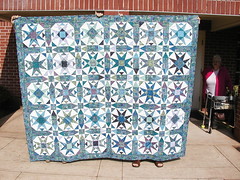
Since the theme for the evening is "Spreading our Wings" (butterflies--also a symbol of the resurrection), we chose a name for the quilt that echoed the theme. To be honest, I have to confess we choose the pattern and had begun the quilt before we knew what the theme was--but it's appropriate, don't you think? Since we're Presbyterians, we would never say this was a coincidence...
Just like the fundraising event, which has outgrown every venue used each year, the skill and ambition of the quilting group has grown. A few years ago we would never have attempted piecing a pattern this difficult: there are about 1000 pieces in it!
People always ask us how long it takes to make a quilt like this. The answer is that we really don't know. The one thing we are sure of is that there is more time and effort put into a quilt like this than most people are willing to pay for.
People always ask us how long it takes to make a quilt like this. The answer is that we really don't know. The one thing we are sure of is that there is more time and effort put into a quilt like this than most people are willing to pay for.
We have members of the group who only cut, iron, hand-sew, machine-sew,or quilt the top together with the batting and back. There are about five people who choose and direct the pattern and the rest of us are very happy to do what we are told. Many hands can either make light work or a big fat mess!!
Our division of labor is totally voluntary--each woman contributes what she thinks she does best. This has always reminded me of St. Paul's teaching about the variety of spiritual gifts: "To each is given the manifestation of the Spirit for the common good." 1 Cor.12:7.
When we first began donating quilts to the school fundraiser, we sold raffle tickets to the congregation, school parents and the community.The first event was held in the church sanctuary and was more like a flea market than a fundraiser.
Our division of labor is totally voluntary--each woman contributes what she thinks she does best. This has always reminded me of St. Paul's teaching about the variety of spiritual gifts: "To each is given the manifestation of the Spirit for the common good." 1 Cor.12:7.
When we first began donating quilts to the school fundraiser, we sold raffle tickets to the congregation, school parents and the community.The first event was held in the church sanctuary and was more like a flea market than a fundraiser.
A couple of years ago as the auctions at the event were bringing in more money so we decided to have the quilt auctioned off.This year we are raffling the quilt again so that more members of the congregation can participate by buying tickets.
This spring our first fifth grade class will graduate from our church school. (We don't have a middle school.) As that group of children who were in our first kindergarten class have grown and developed, so has the school, the church and the Ministers of the Cloth.
One of the reasons I began this blog was to showcase the life and vitality of the Christian witness in a modern mainstream Protestant church. Doesn't this picture equal a thousand words on the subject?
This spring our first fifth grade class will graduate from our church school. (We don't have a middle school.) As that group of children who were in our first kindergarten class have grown and developed, so has the school, the church and the Ministers of the Cloth.
One of the reasons I began this blog was to showcase the life and vitality of the Christian witness in a modern mainstream Protestant church. Doesn't this picture equal a thousand words on the subject?
Friday, April 15, 2005
A taxing day
On this day of rendering unto Caesar, it seems that minor irritations threaten to blossom into full-blown aggravations.
Hence this picture of our kitchen at the close of business today. Sigh. I'm told that most of the work will be completed by the end of next week. Those of you who have lived through remodeling projects will sympathise.
El Jefe continues to take the disruption very well. The Noble Dog has even adjusted to her new sleep chamber: she usually sleeps in the kitchen but now is displaced to the master bathroom.
I miss being able to prepare and eat breakfast there in the morning. The rest of the day I can deal with just fine--even the paint smells and the dust in the air. That surprised me because I thought it would be harder not to be able to use the kitchen in the evening.

Hence this picture of our kitchen at the close of business today. Sigh. I'm told that most of the work will be completed by the end of next week. Those of you who have lived through remodeling projects will sympathise.
El Jefe continues to take the disruption very well. The Noble Dog has even adjusted to her new sleep chamber: she usually sleeps in the kitchen but now is displaced to the master bathroom.
I miss being able to prepare and eat breakfast there in the morning. The rest of the day I can deal with just fine--even the paint smells and the dust in the air. That surprised me because I thought it would be harder not to be able to use the kitchen in the evening.
Popapalooza 2005
It's Friday and time for a little fun!
Check out Popalalooza 2005 for the inside scoop on next week's papal conclave.
Check out Popalalooza 2005 for the inside scoop on next week's papal conclave.

Thursday, April 14, 2005
Praying the Church Will Be On Fire
Today I had a lunch meeting with the other members of the administrative commission that served for a couple of years to the Church Under Fire. (See previous posts March 18 and March 20).
We were celebrating the ministry of the commissioned lay pastor who served as an interim for the past year at this church. He brought each of us a future plan for the church developed by the session, and the further good news that the strong stand taken by the church to bar the troublemaker and his cohorts from the premises has worked so far.
The best news was that the church is now united and the session able to work amicably together to move the church forward. Reminiscing about the experiences we had shared together we all agreed that none of us would have forseen this happy turn of events.
It was a joy to hear the interim pastor relate how prayer and his experience of the Holy Spirit moving in the worship and work of this congregation have saved this church which seemed destined to dissolve in bitter acrimony of the kind we saw when we first met with some members of the congregation.
Legal battles still continue but are now reduced to nuisance-level thanks to the pro bono work of one of the finest Christian lawyers any of us are privileged to know. This was quite an experience for everyone. The lunch was the perfect way to thank the interim for his inspired ministry as he and his family relocate to another part of the state.
With God's help, the Church Under Fire will become the Church On Fire for Christ.
We were celebrating the ministry of the commissioned lay pastor who served as an interim for the past year at this church. He brought each of us a future plan for the church developed by the session, and the further good news that the strong stand taken by the church to bar the troublemaker and his cohorts from the premises has worked so far.
The best news was that the church is now united and the session able to work amicably together to move the church forward. Reminiscing about the experiences we had shared together we all agreed that none of us would have forseen this happy turn of events.
It was a joy to hear the interim pastor relate how prayer and his experience of the Holy Spirit moving in the worship and work of this congregation have saved this church which seemed destined to dissolve in bitter acrimony of the kind we saw when we first met with some members of the congregation.
Legal battles still continue but are now reduced to nuisance-level thanks to the pro bono work of one of the finest Christian lawyers any of us are privileged to know. This was quite an experience for everyone. The lunch was the perfect way to thank the interim for his inspired ministry as he and his family relocate to another part of the state.
With God's help, the Church Under Fire will become the Church On Fire for Christ.
Wednesday, April 13, 2005
Revelations: Omnium Finis Hic
I just finished watching the first installment of Revelations. It is a waste of time, I won't be watching any more of it. Here are some random thoughts about this mini-series.
The show is very broadly drawn and thumps you over the head with its symbolism. After the first episode you know exactly who is the Anti-Christ is and that Christ has returned in the form of an infant miraculously spared after a boat disaster and later baptised at Patmos (get it?).
The producers even milked the recent Terri Schiavo tragedy by including as a character a young girl, Olivia, who was in a persistent vegetative state as the result of a lightening strike. Olivia becomes as a conduit for messages from the deceased daughter of the one of the main characters, Dr. Massey. The writers were tasteless enough to include references to court battles to prevent taking her off life support so her organs could be harvested and scenes reminiscent of the protestors outside the hospice where Terri Schiavo died.
A young nun, Sister Josepha, is the other major character. She is portrayed as insufferably pious and arrogant as she pursues her own crusade to prove "the end of days" is near. She can't speak without spouting verses from the Bible--is that the producer's idea of how a religious person behaves?
NBC just doesn't get it. I think that the program the network chose to air just before the series, and the promos for other shows and movies shown during commercial breaks revealed their inability to identify religion separately from the paranormal, the supernatural and New Age thinking.
Prior to the show, NBC showed an episode of Dateline where the The DaVinci Code was discussed. That seems calculated to lure the target audience to the network and hope they will stay to watch Revelations. The problem is that the author of The DaVinci Code has claimed that his work of fiction is factual when it is demonstrably not and this has angered many faithful Christians.
During each commercial break the advertisements included promos for a TV show featuring a "psychic soccer mom" who said that her ability "comes from a higher place; the movies "The Amityville Horror" and "The Kingdom of Heaven" (not what you might think-it's about the Crusades). Neither mediums nor ghosts are part of the Christian (or Jewish) faith. In fact they are denounced in both the Old and New Testaments. The Crusades were wars fought for religion, power and national pride. "The Kingdom of God" is a curious title for a movie on that subject. Is this another attempt to attract the Christian audience to the theatres?
Someone clearly thinks that using a lot of Latin and chanting in the background lends authenticity and creates a religious mood to the piece. There is a lot of weather of the "dark and stormy night" variety with plenty of dramatic thunder and lightening at just the right moments.
Each segment of the hour began with a quote from the Bible that was designed to heighten the mood of foreboding and was chosen as a proof text to establish the theme of the segment. This is a really poor and irresponsible use of scripture. But hey, the producers never claimed they were responsible or that they were following scripture, did they?
Revelations has the a Latin subtitle (again with the Latin, because you know how Jesus spoke Latin!). Omnium Finis Imminet: translation: the end is near. (Yes, the website for the series translates this incorrectly).
As far as I am concerned, Omnium Finis Hic: the end is HERE.
The show is very broadly drawn and thumps you over the head with its symbolism. After the first episode you know exactly who is the Anti-Christ is and that Christ has returned in the form of an infant miraculously spared after a boat disaster and later baptised at Patmos (get it?).
The producers even milked the recent Terri Schiavo tragedy by including as a character a young girl, Olivia, who was in a persistent vegetative state as the result of a lightening strike. Olivia becomes as a conduit for messages from the deceased daughter of the one of the main characters, Dr. Massey. The writers were tasteless enough to include references to court battles to prevent taking her off life support so her organs could be harvested and scenes reminiscent of the protestors outside the hospice where Terri Schiavo died.
A young nun, Sister Josepha, is the other major character. She is portrayed as insufferably pious and arrogant as she pursues her own crusade to prove "the end of days" is near. She can't speak without spouting verses from the Bible--is that the producer's idea of how a religious person behaves?
NBC just doesn't get it. I think that the program the network chose to air just before the series, and the promos for other shows and movies shown during commercial breaks revealed their inability to identify religion separately from the paranormal, the supernatural and New Age thinking.
Prior to the show, NBC showed an episode of Dateline where the The DaVinci Code was discussed. That seems calculated to lure the target audience to the network and hope they will stay to watch Revelations. The problem is that the author of The DaVinci Code has claimed that his work of fiction is factual when it is demonstrably not and this has angered many faithful Christians.
During each commercial break the advertisements included promos for a TV show featuring a "psychic soccer mom" who said that her ability "comes from a higher place; the movies "The Amityville Horror" and "The Kingdom of Heaven" (not what you might think-it's about the Crusades). Neither mediums nor ghosts are part of the Christian (or Jewish) faith. In fact they are denounced in both the Old and New Testaments. The Crusades were wars fought for religion, power and national pride. "The Kingdom of God" is a curious title for a movie on that subject. Is this another attempt to attract the Christian audience to the theatres?
Someone clearly thinks that using a lot of Latin and chanting in the background lends authenticity and creates a religious mood to the piece. There is a lot of weather of the "dark and stormy night" variety with plenty of dramatic thunder and lightening at just the right moments.
Each segment of the hour began with a quote from the Bible that was designed to heighten the mood of foreboding and was chosen as a proof text to establish the theme of the segment. This is a really poor and irresponsible use of scripture. But hey, the producers never claimed they were responsible or that they were following scripture, did they?
Revelations has the a Latin subtitle (again with the Latin, because you know how Jesus spoke Latin!). Omnium Finis Imminet: translation: the end is near. (Yes, the website for the series translates this incorrectly).
As far as I am concerned, Omnium Finis Hic: the end is HERE.
Pre-Revelations Quiz answers
As promised, here are the answers to yesterday's "pre-Revelations quiz":
1. What is the Revelation of?
The Revelation is of Jesus Christ to his servant John. Revelation 1:1.
2. The book of Revelation is written in what literary form?
Revelation is a letter to the seven churches in Asia. Revelation 1:4
3. What is the meaning of the word "apocalypse"?
Apocalypse means "unveiling".
4. How many times is the rapture referred to in Revelation.
The word "rapture" is never used in Revelation. The rapture, the tribulation and the reconstruction of the temple are ideas from other parts of the bible and are not mentioned by John.
5. Are there any beatitudes in Revelation?
There are 7 beatitudes in Revelation. Revelation 1:3, Revelation 14: 13, Revelation 16: 15
Revelation 19:9, Revelation 20:6, Revelation 22:7 and Revelation 22:14.
1. What is the Revelation of?
The Revelation is of Jesus Christ to his servant John. Revelation 1:1.
2. The book of Revelation is written in what literary form?
Revelation is a letter to the seven churches in Asia. Revelation 1:4
3. What is the meaning of the word "apocalypse"?
Apocalypse means "unveiling".
4. How many times is the rapture referred to in Revelation.
The word "rapture" is never used in Revelation. The rapture, the tribulation and the reconstruction of the temple are ideas from other parts of the bible and are not mentioned by John.
5. Are there any beatitudes in Revelation?
There are 7 beatitudes in Revelation. Revelation 1:3, Revelation 14: 13, Revelation 16: 15
Revelation 19:9, Revelation 20:6, Revelation 22:7 and Revelation 22:14.
This morning I read a review of the Revelations series that begins airing tonight. Since both Jerry Jenkins, one of the Left Behind authors, and Frederick Smith, a professor at SMU, trashed the series it may be a complete bust. These men have widely different interpretations of Revelation and the Bible in general and neither one of them like it!
While I am glad to see that mainstream television producers are trying to write shows that will appeal to Christians, it is discouraging that they can't resist the impulse to sensationalize their subject matter. According to this review, other shows being considered feature a contemporary Jesus appearing to a troubled Episcopal priest and a spiritual "X-files" drama featuring an excommunicated priest. How about a show that features an ordinary ("quotidian" if you will) minister striving to serve the spiritual needs of a medium size congregation in anywhere USA? I promise you that pastors like that have lots of compelling stories to tell --without resort to the invocation of poltergeists, apocalyptic imagery and whiffs of spiritualism and New Age blather.
While I am glad to see that mainstream television producers are trying to write shows that will appeal to Christians, it is discouraging that they can't resist the impulse to sensationalize their subject matter. According to this review, other shows being considered feature a contemporary Jesus appearing to a troubled Episcopal priest and a spiritual "X-files" drama featuring an excommunicated priest. How about a show that features an ordinary ("quotidian" if you will) minister striving to serve the spiritual needs of a medium size congregation in anywhere USA? I promise you that pastors like that have lots of compelling stories to tell --without resort to the invocation of poltergeists, apocalyptic imagery and whiffs of spiritualism and New Age blather.
Tuesday, April 12, 2005
Pre-Revelations Quiz
I can't remember the last time that I watched a mini-series on network TV, but I'm planning to watch Revelations which begins tomorrow night on NBC. A few years ago I taught a class on the Book of Revelation. I used Bruce Metzger's Breaking the Code as the primary text for the class but also brought in parallel commentaries that explained the different approaches to interpretation of the text. It was fascinating to me and I came away with a deep appreciation of this difficult book.
How will Hollywood handle this subject? The director says he titled it "Revelations" not "Revelation" because his script includes the "revelations" that the individual characters have in the course of the movie. The print publicity claims that the series is meant to be respectful of the subject matter and will not present it literally. However, the video clips promoting it on TV are sensational enough that they could be previews of The Exorcist. So I am planning to blog on each episode as they air, unless I decide it's a waste of time.
Here is a little pre-Revelations quiz, to see how much you know about this much-misinterpreted book of the Bible:
1. What is the Revelation of?
2. The book of Revelation is written what literary form?
3. What is the meaning of the word "apocalypse"?
4. How many times is the rapture referred to in Revelation?
5. Are there any beatitudes in Revelation?
I'll post the answers tomorrow and if any of you watch the series, I would love for you to post your reaction to it as a comment here.
P.S. Will Spotts has a great post on Presbyterians and Catholics on the PCUSA Elders blog today.
How will Hollywood handle this subject? The director says he titled it "Revelations" not "Revelation" because his script includes the "revelations" that the individual characters have in the course of the movie. The print publicity claims that the series is meant to be respectful of the subject matter and will not present it literally. However, the video clips promoting it on TV are sensational enough that they could be previews of The Exorcist. So I am planning to blog on each episode as they air, unless I decide it's a waste of time.
Here is a little pre-Revelations quiz, to see how much you know about this much-misinterpreted book of the Bible:
1. What is the Revelation of?
2. The book of Revelation is written what literary form?
3. What is the meaning of the word "apocalypse"?
4. How many times is the rapture referred to in Revelation?
5. Are there any beatitudes in Revelation?
I'll post the answers tomorrow and if any of you watch the series, I would love for you to post your reaction to it as a comment here.
P.S. Will Spotts has a great post on Presbyterians and Catholics on the PCUSA Elders blog today.
Monday, April 11, 2005
Not really a Quaker
A few days ago I posted a link to a little online quiz called What Denomination Are You Really?
I emailed the link to friends and family and we have had an interesting time comparing and discussing our results.
My brother, an Episcopalian by choice and marriage, found himself categorized as Eastern Orthodox. Portia was told she should be a Methodist and is puzzled about it. Although one of our pastors was fortunately rated as a Presbyterian/Reformed, his runner-up denomination was Eastern Orthodox and he can't figure that out either. El Jefe and Babs rated as Presbyterian/Reformed. We're still waiting to hear from a few others.
We've had some lively discussions about which answers were "right" and how they may be used to define the results you get. Some of the questions were obvious and some were not. We also wondered how your result would be changed by "don't know" answers.
A few years ago there was a similar online quiz that I took. If memory serves, it had a lot more questions. That quiz said I should be a Quaker! Not really. These quiz questions are on theology and church government and do not include social and political issues that these denominations may have. It occured to me that if those types of issues were included, I might not have had my Presbyterian result.
The quiz is a good reminder that none of us are in complete accord with every aspect of our denominational traditions. We are drawn to the churches we attend for many reasons, not all of which include acceptance of each theological doctrine or polity structure. The community of other Christians and our life together in the congregation is the most important tie that binds us to the churches we join.
I emailed the link to friends and family and we have had an interesting time comparing and discussing our results.
My brother, an Episcopalian by choice and marriage, found himself categorized as Eastern Orthodox. Portia was told she should be a Methodist and is puzzled about it. Although one of our pastors was fortunately rated as a Presbyterian/Reformed, his runner-up denomination was Eastern Orthodox and he can't figure that out either. El Jefe and Babs rated as Presbyterian/Reformed. We're still waiting to hear from a few others.
We've had some lively discussions about which answers were "right" and how they may be used to define the results you get. Some of the questions were obvious and some were not. We also wondered how your result would be changed by "don't know" answers.
A few years ago there was a similar online quiz that I took. If memory serves, it had a lot more questions. That quiz said I should be a Quaker! Not really. These quiz questions are on theology and church government and do not include social and political issues that these denominations may have. It occured to me that if those types of issues were included, I might not have had my Presbyterian result.
The quiz is a good reminder that none of us are in complete accord with every aspect of our denominational traditions. We are drawn to the churches we attend for many reasons, not all of which include acceptance of each theological doctrine or polity structure. The community of other Christians and our life together in the congregation is the most important tie that binds us to the churches we join.
Subscribe to:
Posts (Atom)