Shuttered windows
Warm dark and gloomy rooms
Saving electricity
Dogs napping all day
One hundred six degrees outside
Too hot to play
Grass crisp and brown
Sun hot and bright
Tree branches breaking
No one walking
Alligators, deer, feral hogs
Looking for water
In the suburbs
Tomorrow is promised
Cloud like a man's hand
Will bring relief to us
Quotidian means commonplace or everyday. "For by grace you are saved." Ephesians 2:5
Wednesday, August 31, 2011
Monday, August 29, 2011
Back From FOP and In Context
It takes me a couple of days of thinking about an intense experience like the Fellowship of Presbyterians (hereinafter affectionately termed "FOP") before writing about it. We got back from Minneapolis last Friday evening and plunged back into everyday life over the weekend.
At church today I was asked numerous times "What happened?" and "How did you feel about it?" So here are my answers to those two questions.
What happened was that 2,000 Presbyterians representing more than 800 congregations had several amazing, inspiring worship services spread over the two day period. We spent most of our time grouped in 195 tables of ten people each. I was privileged to be a table leader and met Teaching and Ruling Elders from all over the country . I learned a lot about other congregations.
Presentations about the "Four Tiers" (or options) that the FOP leadership had developed for the consideration of those present. After each one we were offered questions to guide discussion and the leaders emailed questions and opinions from the group.
The Tiers are: to remain in place, to create "presbyteries within presbyteries", to create parallel divisions of presbyteries, and to create a New Reformed Body (NRB) which would allow congregations to withdraw from the PCUSA and join the NRB, or affiliate with the NRB while remaining in the PCUSA. Except for the first, all of these options are in the broad concept stage and require more definition.
As you can imagine, Tiers Two through Four generated the most conversation and questions. At the end of the day my group asked me to send a message stating that they unanimously believed that the only two realistic options were to remain in place or develop the NRB and that was were the FOP effort should be focused. All the other group leaders I discussed this with told me that was also the conclusion of their table groups. That's a very unscientific survey, but I offer it for whatever it is worth.
We also had the opportunity to attend break-out sessions that covered a range of topics from Leadership in Times of Radical Change to What Are the Theological Essentials as well as more conversation about the four tiers. Our church group made assignments so we wouldn't duplicate attendance at the sessions. My assignment was Connecting with the Global Church which was, well, meh.
"Context" was the buzzword of the day. The FOP leadership repeatedly emphasized that the context each congregation operates within (its presbytery, its membership, its pastoral leadership) is bound to differ and must be respected.
Here's how I feel about it.
The FOP Gathering met or exceeded my expectations, which were to see those gathered begin to come together around a way forward even though that way is not yet clearly defined. I was pleased with the positive focus on the new thing God may be doing as well as respect for those with whom we differ. I welcome the discussion about defining the "essential tenets because I have led elder training and had to hem-haw around when asked what were the "essential tenets" they were being asked to affirm in their ordination vows. I've never been comfortable with that lack of definition, but maybe that's just my personality.
I am encouraged that the emphasis is on forming a "bottom-up" rather than a "top-down" movement and that regional gatherings are planned for the fall as well as a Constitutional Convention for January 12-14 in Orlando, Florida. Presumably there will be more definition of the movement, especially the NRB concept, before that convention in January.
I think that at FOP I was "seeing through a glass darkly" and hope that as it evolves, clarity and light will emerge.
Tuesday, August 23, 2011
Preparing for #MN2011
Eleven of us from our church will be flying out tomorrow to Minneapolis for the big Fellowship of Presbyterians Gathering. I'm looking forward to escaping the 100 degree days here, but from the looks of the schedule, am not likely to spend any time outdoors in the cooler weather there.
With close to 2,000 registered, this event promises to be a larger gathering of Presbyterians than the biannual General Assembly meetings. I've agreed to be a table leader which means I will be assigned a group of 10 participants who will meet periodically throughout the two day meeting for discussion. Table leaders are also going to communicate feedback and questions from their groups which will be fed into the Q&A sessions that are scheduled. Have IPad, will travel!
The meeting has its own Twitter hashtag (#MN2011). Don't hold your breath for any tweets from me since I'll be busy facilitating a group. I'm sure others more adept than I at digital multi-tasking will keep the tweets flowing.
I hope to meet some of my Gentle Readers and Facebook friends there. Let me know in the comments if you are going.
Thursday, August 18, 2011
Book Review: Rome and Jerusalem by Martin Goodman
Our recent trip to Israel piqued my interest in reading more about the country. One of the books recommended to us by our guide was Rome and Jerusalem: The Clash of Ancient Civilizations by Martin Goodman.
When you read the New Testament you are aware that the power and influence of Rome surrounded Jesus, the disciples, Paul and the early church. But a trip around Israel, with numerous Roman ruins and relics, makes the Roman presence very real.
At 624 pages, Rome and Jerusalem is not light reading--in both senses of that adjective! So I am glad that I read it on my IPad instead of in hardcover.
Goodman covers the period between the first and fourth centuries A.D. The destruction of the temple and the expulsion of the Jews from Jerusalem in 70 AD is, of course, the focus of the book. For most of the period prior to the destruction of the temple Rome allowed the Jews much religious freedom because they respected the antiquity of their religion. Why this relatively benevolent attitude changed is attributed by Goodman to the foundational differences between Roman and Jewish culture, religion and practices.
Comparing and contrasting Roman and Jewish lifestyles, politics, identities, communities and perspectives, Goodman reveals the distinct and unreconcilable differences between these two civilizations that ultimately led to the destruction of the ancient Jewish state. The author makes a persuasive case for his theory that the origins of anti-semitism can be found in the Roman response to this clash and the attempt to wipe out the Jewish nation.
Wednesday, August 17, 2011
Of Opera and Mac and Cheese
So, Babs and I flew up to D.C. last weekend to see the Diva perform in Tales of Hoffman at Wolf Trapp. Of course she was fabulous!
The next night Catherine picked out a very nice seafood restaurant for dinner. They had lobster mac and cheese on the menu. Of course we were all about that!
The waiter said he would give us a free dessert if we could guess the "secret cheese" in the macaroni which he said had several different cheeses. After one bite I said, "Velveeta". I was right! The waiter said he had made that offer 10 times and I was the first one to win.
Quoth Babs: "We're Texans. We know our queso!"
Thursday, August 11, 2011
Book Review: Jesus, My Father, the CIA and Me by Ian Morgan Cron
Intrigued by the title, I accepted the offer from Thomas Nelson publishers of a review copy of Jesus, My Father, the CIA and Me by Ian Morgan Cron. The author is an Episcopal priest in Greenwich, Connecticut. I was not familiar with him, but he wrote another book, Chasing Francis: A Pilgrim's Tale, and apparently is on the speaking circuit as well.
Cron's father was a brilliant and handsome man who made and lost several fortunes as his growing addiction to alcohol took over his life. The author, as the youngest child in the family, had the worst experience as his older siblings had left home by the time their father turned violent and abusive.
Cron calls his work "a memoir of sorts". This is not a traditional biography or autobiography, but a gradual revelation of who and what his father was as the author experienced it growing up.
As a young adult Cron learns that his father is actually a CIA operative and that this explains the long, unexplained absences from home that punctuated his childhood. His father's work history turns out to be a series of "covers" for his intelligence gathering assignments.
So how does Jesus fit into all of this? Cron weaves the story of his own spiritual journey in parallel to the story of his relationship with his father. As a young boy he was drawn to God and to the church but as a teenager, in reaction to the disfunctional and frightening dynamics of his family, rejects faith in a fury at a God who seemingly does not hear his prayers for relief.
But Jesus keeps calling to him, even as he experiences his own spiral into alcohol abuse as a young adult. Cron's resolution of his spiritual crisis eventually comes when he hears a voice saying "I'm sorry" during a communion service. For years he puzzles over whether or not this voice could have been the voice of Jesus or was it an apology he was making to himself. Several years later, while in seminary in Denver he shares his question with "Miss Annie", an African American woman who was a member of the church he was attending.
Her answer, which I am going to summarize with her last words: "Son, love always stoops", is one of the most grace-filled moments I have ever read.
The author is painfully honest about how the pain of his childhood informed, and continues to inform his life. His faith and relationship with Jesus help him to recognize and try to amend the ways in which he is tempted to repeat the patterns he learned growing up in an alcoholic family where the secrecy imposed by his father's employment with the CIA reinforced the impulse to denial and secrecy.
Jesus, My Father, the CIA and Me is well written and, at times, compelling. The theme of substance abuse and its effect on the extended family that Cron explores from his personal experience will resonate with many readers. His testimony to the transformative power of faith will inspire them as well.
Tuesday, August 09, 2011
Book Review: Doc by Mary Doria Russell
Mary Doria Russell is one of my favorite contemporary authors of literary fiction. The only reason I bought the kindle copy of this book is because it is her latest novel. I never expected to become enthralled with a historical novel about Doc Holliday, of "gunfight at the OK Corral" fame. But I did and I bet you will too.
Those of you who are already fans of Russell will not be disappointed. Those of you who have not yet read one of her books have a real treat in store.
Russell did a lot of historical research about John Henry Holliday, his life and times, and writes a compelling tale about the infamous gambler and gunman who began life as the son of a genteel Georgia family scrambling to survive in the post Civil War south.
Holliday contracted tuberculosis at an early age and, having lost his mother to the same deadly disease at age 15, traveled west in an attempt to find a cure or remission. He appears in Dodge City, Kansas which was then a lawless cattle town where he takes up with the Earp brothers and Bat Masterson. Trained as a dentist, he tries to establish a practice there, but finds his skills at cards a surer way to support himself than dentistry.
One of Russell's greatest strengths is character depiction. Doc, his prostitute girlfriend Kate, the Earp brothers, Masterson and bevy of minor characters are believable and complex.
For those of you who know the nickname of the author's book The Sparrow, ("Jesuits in Space"), you will recognize the character of Father Alexander von Angenspurg as the "Jesuit in the Wild West." I particularly loved the character of Father Alex, especially when he turned to the letters of Paul to Timothy to guide him as he replaced a beloved older priest at the Indian missions.
Another memorable character is Kate, the highly educated prostitute who was born to be a lady in waiting to the court of Maximillian in Mexico but had to learn to live by her wits and her body when that regime was overturned and she fled to the United States.
The novel focuses on Doc's "nightmare life in death"-- the long slow process of dying of tuberculosis in an era where there were no drugs to cure or control it. This gives the author many opportunities to explore Doc's varied responses to his mortal illness and its effects on those around him. At one point he tells Morgan Earp, "Flaubert tells us that three things are required for happiness: stupidity, selfishness and good health, I am," he told Morgan, "an unhappy man." Doc is neither stupid, selfish, and certainly is never in good health.
The story is beautifully written, dramatic, and philosophical. That's quite a combination and is a testimony to the skill of the author. I give Doc: A Novel my highest recommendation.
I have previously reviewed these other novels by Mary Doria Russell: Dreamers of the Day, A Thread of Grace, and The Sparrow and The Children of God.
Wednesday, August 03, 2011
Book Review: The Countertenor Wore Garlic by Mark Schweizer
Just when the circus in Washington DC and the doin's of the PC(USA) were starting to seriously work on my last nerve along came Mark Schweizer's latest Liturgical Mystery: The Countertenor Wore Garlic.
Okay, True Confession, the book didn't just come along, I was hoping it was about time for a new entry in the series (this is number 9) and surfed the net hoping to find it. Faithful Readers of QG know I really LOVE this series.
All the craziness of the world drops away from me when I read one of these entertaining mysteries. If you are a church music nerd and spend more than your share of time on vestries, sessions or church committees, you will relate to the adventures of our hero, Hayden Konig, in his role as church organist at St. Barnabus Episcopal Church of St. Germaine, NC, even if you've never been a police chief like he is.
Countertenor takes place during Halloween. A famous author of vampire novels comes to town for a book signing, attracting teenage vampire fans in addition to the annual influx of fall foliage tours. Meanwhile St. Barnabus is once again between priests and the temporary replacement, Vicar Fearghus MacTavish, a Scottish priest with decidedly Calvinist views, heads toward an inevitable clash with the Congregational Enlivener in one of the funniest scenes in the entire series.
Oh, yes, there is another murder to solve, too, as well as our hero's continuing attempts to write mysteries like Raymond Chandler. Which are scarily getting better rather than worse.
My only criticism of this one is that there was too little MacTavish! I would love to see him take on the Giant Paper Mache' Calvinist Puppets of Doom in addition to the Congregational Enlivener. And Brenda, the Christian Educator character, would be just the type to bring in those puppets.
I bought and read the Kindle version and will probably read it again as soon as my last nerve is again inflamed. Which will probably be tomorrow.
Monday, August 01, 2011
Holy Land Tour: Looking Back, Looking Forward
Our trip to Israel was an awesome experience. We came back refreshed and inspired with a faith deepened by everything we had seen and heard. Dave Peterson's messages reinforced our purpose in being there and turned a trip into a pilgrimage.
We were blessed to travel with other members of our church who each brought a special insight to the experience. In fact the group bonded so well that we are continuing to meet each Wednesday night to share our photos, notes and different viewpoints about the trip.
After our return, I had the opportunity to join a Jewish/Presbyterian dialogue group sponsored by our presbytery. I've been to my first meeting and look forward to continuing the conversation. Our group invited our General Presbyter, Mike Cole, to speak about it in a couple of weeks.
El Jefe and I always thought that going to Israel would be a once in a lifetime experience. But we've changed our minds. We want to go back.
Friday, July 29, 2011
Holy Land Tour: Eilat for a Day
As I mentioned yesterday, Eilat is a resort at the southernmost tip of Israel on the Red Sea. It has beautiful water and beaches and the beachfront is filled with luxury hotels. I got this photo off the web:
We had a free day in Eilat before our flight the next day to Tel Aviv and then home. El Jefe was intrigued with the idea that you can see Jordan, Egypt and Saudi Arabia from the Red Sea, so we hopped on a glass bottomed boat that went far enough out from shore to get that view. This is the Egyptian shoreline as seen from the boat.
We were the only Americans on the boat, and the skipper was nice enough to come let us know when it was time to go down and see the coral reef through the glass since all the announcements were in Hebrew.
I nearly passed out from the heat as we walked back from lunch! No wonder our travel coordinators told us that they did not bring groups any later than this because of the heat. The tour was also catching up with us so we had a nice nap and then joined our group for dinner in a fine seafood restaurant before going back to pack up and prepare to go home.
Thursday, July 28, 2011
Holy Land Tour: Petra
We arrived in Eilat late in the afternoon and checked into our hotel which reminded me of resort hotels in Mexico. In fact Eilat is a popular resort town on the Red Sea, filled with tourists and elaborate beach-side hotels.
Bright and early the next morning we went to the border to cross into Jordan at Aqaba. It took us about 45 minutes to be cleared by the Jordanian border guards. They took our passports, which made me more than a little bit nervous.
Once we were cleared, we walked a few yards to the bus that had been arranged to take us to Petra. There we were joined by our Jordanian guide, Ziad, and a member of the Jordanian Tourism Police complete with sidearm.
Ziad gave us some background on Jordan and explained that 70% of the country is desert. It was a very bleak landscape, indeed. We saw Bedouin settlements in the caves like this:
Ziad said the Jordanian government was trying to extend education to the Bedouin children but could not get teachers to go to these settlements, so soldiers were ordered to go and teach for a year at a time. Wonder how that is working out?
Petra does not have any religious or Biblical significance. It is a magnificent city carved into the desert rocks by the Nabateans more than 2,000 years ago and was an important trading center. The Romans conquered it in 106 AD and built administrative offices in the steep mountainside, but abandoned it because of devastating earthquakes. Petra is one of the wonders of the world and the most important tourist attraction in Jordan.
Perched on the tops and sides of the mountains is the modern city of Petra:
Once the bus dropped us off at the entrance to the site, we walked more than a mile through a deep gorge called the Siq:
This path reminded me of the many Biblical admonitions about straying from the narrow path! There were many slick spots and uneven ground to navigate, so I found myself looking down most of the time we were walking.
As you get to the end of the Siq, there is a dramatic view of the most important structure in the site--the Roman Treasury:
There was so much glare from the high desert sun that I got that reflection in the photo. Across from the Treasury was this building which I believe the Romans used for other government functions:
It was HOT there! Even the camels seemed to be feeling the heat:
Most of us--including El Jefe and me--took advantage of the horse-drawn buggies to bring us back up to the entrance to the ancient city. It was a teeth-rattling ride!
Some of the intrepid travelers in the group opted to spend the night at a nearby hotel so they could see the light show in the evening at the ancient city and then climb up early in the morning to the top of the mountain to see the remains of an old monastery. El Jefe and I were not in that group, but went back to Eilat that evening. However, I can share this stunning photo of Petra at night, with thanks to Sam Gainer who took it:
Wednesday, July 27, 2011
Holy Land Tour: Independence Hall
After lunch in a nice cafe in Tel Aviv, we toured Independence Hall. As the name suggests, this is the place where the Israeli Declaration of Independence was signed. Once a private home, the building is now a museum with exhibits related to the Israeli Declaration of Independence.
The Declaration was announced by Israel's first Prime Minister, David Ben Gurion on May 14, 1948 to the members of the Jewish National Council just a few hours before the expiration of the British Mandate over the area. We viewed a brief video explaining this history and then went into the assembly hall where it all took place.
The hall itself is rather spare and not very large and reminded me of Independence Hall in Philadelphia, minus the Greek Revival architecture.
The Declaration was announced by Israel's first Prime Minister, David Ben Gurion on May 14, 1948 to the members of the Jewish National Council just a few hours before the expiration of the British Mandate over the area. We viewed a brief video explaining this history and then went into the assembly hall where it all took place.
The hall itself is rather spare and not very large and reminded me of Independence Hall in Philadelphia, minus the Greek Revival architecture.
There were a couple of striking murals in the hall as well:
Two buses waited for us on the busy Tel-Aviv street as we left Independence Hall. One took those returning to Houston back to the hotel in Tel-Aviv and then to the airport. El Jefe and I boarded the other one bound for Eilat, at the southernmost tip of Israel. Our wonderful guide, Lee Glassman, did not go with us to Eilat, and we hated to part with him! The rest of the day we drove once again through the punishing desert country to the Red Sea.
Tuesday, July 26, 2011
Holy Land Tour: The Bullet Factory
It was Day 10 of our tour and before our group split up--some to return to Houston that evening and the rest of us to travel to Eilat and Petra--we made a couple of visits to sites important to the recent history of the state of Israel.
The first one was at Rehovot, a kibbutz where a secret bullet factory was hidden underground beneath the communal bakery and laundry.
During the time of the British Mandate in Palestine, and before independence, Jews were forbidden to have weapons as British forces tried to stop the movement for independence. Weapons were smugged in but ammunition was not available. The penalty for being caught with weapons or ammo was death by hanging.
An underground resistance group formed among the residents of this kibbutz. They set up their secret bullet factory right across the street from a British police station and told the British they were making a refrigeration plant as a cover story for the supplies they brought in to make the bullets.
Most residents of the kibbutz were not aware of the factory and the few who were took great care not to give away the secret. The site is now a national historic property and has displays re-enacting the work of the Bullet Factory.
Here are photos of the entrance and the laundry:
The atmosphere underground was stifling and the machines used to make the bullets were antiquated, but the secret factory successfully produced munitions for the independence effort and was never discovered by the British.
Here are a couple of photos showing re-enactments of the factory in action:
Afterwards we gathered in a grove of trees outside the Bullet Factory and said farewell to those who were leaving to return home. Although we had one more stop to make before splitting up, there wouldn't be another good opportunity to do that.
Monday, July 25, 2011
Holy Land Tour: Beit Guvrin Dig
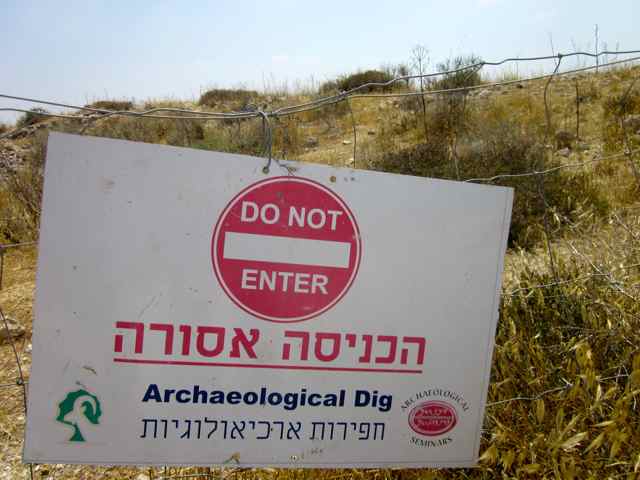
It was our very own Indiana Jones moment--a chance to play archaeologist at an Israeli dig! El Jefe had been very excited about this stop since he heard we would be making it.
The bus took us from the IDF base to Beit Guvrin and a nearby national archaeological site where the ruins of the ancient Judean city of Maresha are being excavated. Maresha was originally settled by Edomites, who are traditionally said to be the descendants of Esau. Maresha is mentioned in Joshua and later in Chronicles as a fortification. Later the Edomites migrated to the area and became a major city.
Our guide, Lee Glassman, told us that because of budgetary cuts the project didn't have enough people to work on the excavation so they welcomed amateurs like us. Our assignment was to climb down into this cave, which was more than a little bit scary:
And begin filling buckets with the debris on the ground. The story of this area was that the Edomites abandoned this site when the Jews in the area told them to convert or leave. The caves were made by the Edomites and used like basements for storage. Therefore we could expect to find lots of pottery shards, and if we were lucky, maybe we would find some large pieces. Here are our buckets after a couple of hours' work:
When the project organizers called a halt to filling the buckets, the next step was to get those buckets out of the underground cave and up onto the surface. So we formed a bucket brigade and hoisted the debris up the rickety ladder.
I got to be on the ground floor:
But El Jefe bravely took his position near the top of the ladder:
It was a relief to get out of the dusty cave--made more dusty by all that scooping of earth--and outside where we sifted the dirt and collected several buckets of pottery shards. The staff took the shards and they actually work on trying to put the pieces back together again like the world's most impossible jigsaw puzzle.
The biggest thrill of the day was finding this:
It is the top of a large amphora used for storing wine and even though it is just the top we were told it was "museum quality."
What became of the Edomites? Our guide told us that they eventually became Christians. I did a little internet research and while I cannot confirm that story, I like it.
Friday, July 22, 2011
Holy Land Tour: IDF Military Base
The afternoon after our last full day in Jerusalem we met for a worship service in a lovely outdoor arena next to the Inbal Hotel where we were staying. Dave preached on the Exhibition of the Kingdom of God to Humanity and we shared communion together. At his request, I led the group in singing " Blest Be the Tie That Binds" and the Doxology.
At dinner that evening everyone shared their experiences and what they found most meaningful about the trip. We were going to travel back to Tel Aviv the next day as about half of the group were departing for home the day after.
However, our trusty tour bus had scheduled stops along the way. The first stop was at an Israeli Defense Force Signal Training Facility and brought the reality of modern Israeli life in the Midde East back to our attention.
The tour of the base was arranged by Friends of the IDF. Since returning home, I have learned that a stop at one of the IDF bases is often included in tours. The Israelis, with good reason, are eager to improve and strengthen their relationship with the United States by reaching out to American tourists. We were warmly greeted and encouraged to visit with a group of the young IDF soldiers and one of their commanders who said they hadn't had visitors in quite a while -- no doubt because the Arab Spring conflicts discouraged travelers.
You can see by this photo that most of the soldiers at this base are young women. We were told that is because women are not put into combat roles, but trained for support roles and this base was a training facility for computer technology. All Jewish Israelis must serve in the IDF. Women serve for two years and men for three years after graduation from high school. Israelis who are not Jewish may volunteer to serve and the soldiers told us that some of them do.
We had seen IDF soldiers serving in different contexts on our tour but this was the first time we talked with any of them. They made a presentation about their training and answered questions. A few times their commander responded "I can't tell you that."
Apparently you can't leave the base without having your picture taken in front of a tank. Must be a law or something. El Jefe has his Friends of the IDF cap on and we both are dressed for the archaelogical dig which was our next stop of the day.
Thursday, July 21, 2011
Holy Land Tour: Yad Vashem, The Holocaust Museum
The day continued on a somber note as we traveled by bus to Yad Vashem, The Holocaust Museum, located several miles away from the old city on top of one of the Jerusalem hills. The name of the museum comes from a verse in Isaiah:
"And to them will I give in my house and within my walls a memorial and a name (a "yad vashem")... that shall not be cut off." Isaiah 56:5
After entering the reception area of the museum we passed through the Avenue of the Righteous Among the Nations which honors Gentiles who risked -- and sometimes lost-- their own lives trying to rescue Jews from the Nazi's "final solution." For example, Oscar Schindler of "Oscar's List" is honored with a tree and a plaque on the avenue.
Photography is not permitted inside the museum, so I don't have any interior photos to share. The architecture is very effective: you enter into a wide corridor that opens into rooms on either side for the exhibits and as you walk through the museum the pathway narrows until it brings you out into the light. Our guide explained that it was meant to replicate the passageways Holocaust victims walked on their way to the gas chambers. A chilling thought.
One of the most inspiring stories in the museum involved a bicycle that was suspended from the ceiling. Since I couldn't take a picture of it, our guide Lee Glassman kindly sent me a picture he had of the bicycle just before it was taken to the museum for display.
This bicycle belonged to Marie Rose Gineste, a young woman who was the secretary of a Catholic church in Montauban, France. The bishop of the area--who is also honored among the Righteous Among the Nations--prepared a letter of protest begging his flock to "go forth and protect Jews from deportation" by the Nazis who now controlled the country.
Marie Rose persuaded the bishop not to mail the letters because the post was no longer secure. She volunteered to deliver the letters in person and rode this bike more than 62 miles, distributing copies of the letter to all priests in the diocese. She continued to shelter Jews throughout the war.
Rose Marie kept the bicycle and continued to use it until she was 89 when she shipped it to Jerusalem for the museum. She said she kept it because it reminded her that at one time in her life she had done something really important. This photo is from a website.
![]() |
| Marie Rose- Gineste and her bicycle |
A separate building on the grounds is a memorial to the children who lost their lives in the Holocaust. It was a moving and beautiful symbolic display inside a room with a very high ceiling. Hundreds of tiny lights swirled around thedarkened room. These unfinished pillars are just outside the memorial, symbolizing the thousands of young lives cut short.
Tears welled up in my eyes as we left this place and others in our group were sobbing as well. It was an emotional morning, but a very important stop on our tour.
Wednesday, July 20, 2011
Holy Land Tour: The Western "Wailing" Wall
We moved on to the Western Wall, where signs reminded us that this is a sacred place.
We had a tour of the archaelogical excavations of the underground area. Squeezing through some very tight spaces we made our way through the tunnel that had been constructed, coming upon a group of women crying and praying in a small area. Our guide told us they came there to pray because it was the area believed to be closest to where the Holy of Holies had once rested. I didn't take any photos here because it seemed too intrusive. Here is one photo I took that did come out that shows the entrance to the underground tunnel.
Finishing the underground tour, we took a few minutes to approach the Western Wall area known as the "Wailing Wall." It is divided into two different spaces: one for men and one for women, following Orthodox Jewish custom. Slips of paper are available for those wishing to leave the names of deceased loved ones as a prayer in the niches between the stones.
El Jefe left the names of his late partner, John Heard, who was a great friend of Israel and of Helen Rosenbaum, a Holocaust survivor and the late mother of another partner and friend. I left the names of my niece, M.E., our nephew Patrick Nicosia, and our beloved friend Diana Adams. May light eternal shine them.
As we were leaving in a somber mood, we passed a group of young schoolboys with their teachers, wearing paper crowns, skipping and running exuberantly.
Tuesday, July 19, 2011
Holy Land Tour: Southern Steps
Bright and early the next morning we returned to the old City of Jerusalem and went to the Southern Steps of the Second Temple which is now a national park.
Our group gathered on the Southern Steps while Dave led us in a devotion based on one of the Great Ends of the Church (all the devotions were based on one of the Great Ends): The Preservation of the Truth. He closed with a quote from Robert Frost, " You don't abandon truth because it is no longer in fashion. Wait a while and it wil come back."
These are the ruins of the steps that Jesus walked on to go up into the temple. From these steps you can see the Mount of Olives where the Garden of Gethsemane and the place of Jesus' ascension to heaven are located. I was impressed by the close proximity of these important places in Jerusalem.
On the western side of the Southern Steps you can walk down to see the excavation of the wall which reveals the stones thrown down by the Roman soldiers when the Temple was destroyed.
Subscribe to:
Posts (Atom)